From Omegle to 2026: A Short History of Random Chat
"Talk to strangers" is one of the internet's oldest promises — older than the web itself. Before there were browsers, before there were search engines, before anyone had a profile picture, people were dialling into distant machines for one reason above all others: somewhere on the other end was a person they had never met. Everything since — Chatroulette, Omegle, and the wave of chat sites you can open today — is a variation on that original promise. This is the story of the genre.
The pre-history: IRC, AOL, and the age of the chat room
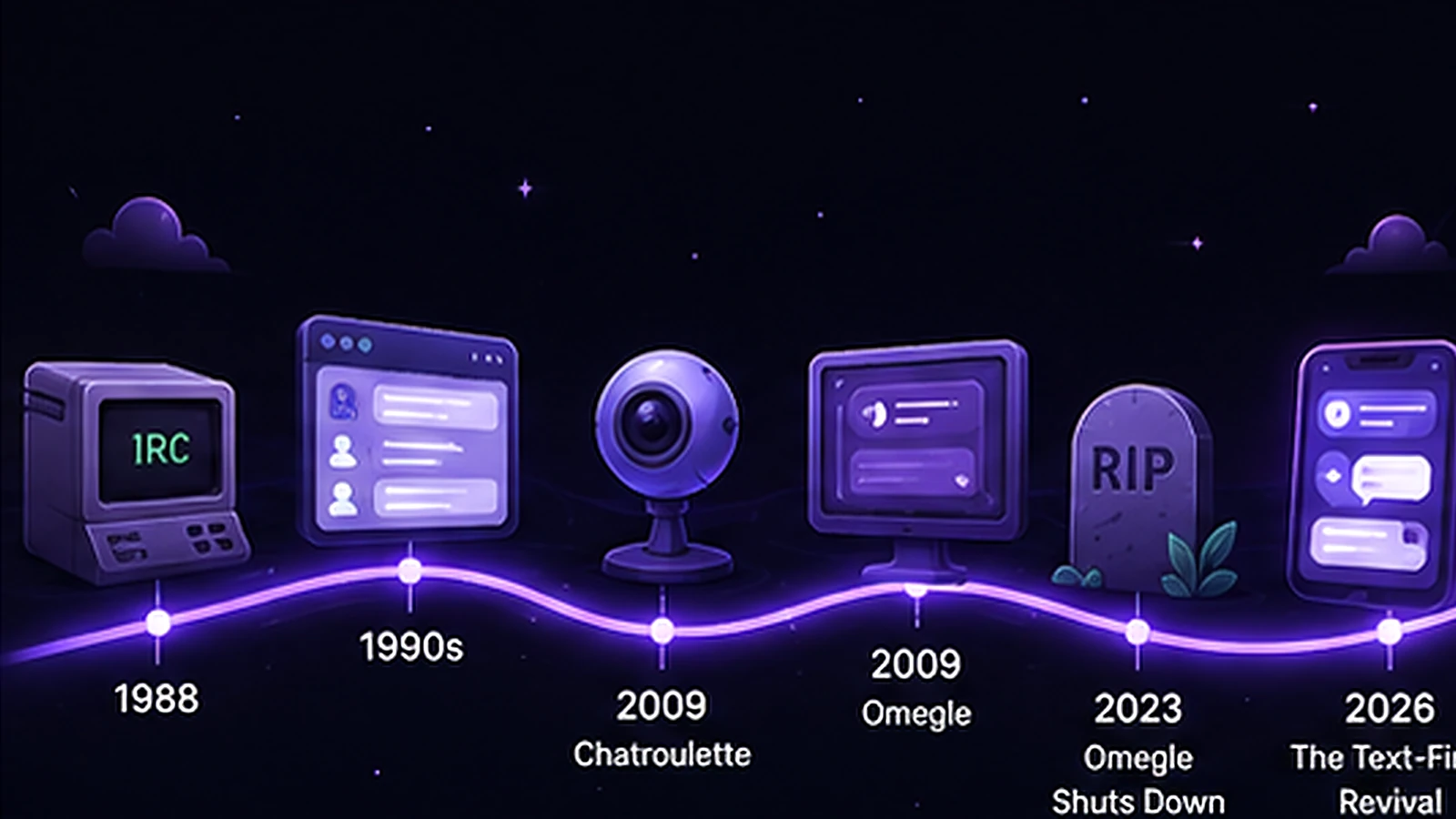
In 1988, a Finnish student named Jarkko Oikarinen wrote Internet Relay Chat — IRC — so people on different machines could talk in real time. It spread across universities and then across the world, and it established the template every chat platform still follows: channels full of strangers, throwaway nicknames, and conversation as the whole point.
The 1990s took that template mainstream. AOL's chat rooms became, for millions of households, the first taste of the internet as a social place — you'd pick a room by topic and simply start typing at whoever was there. AIM and early web-based chat rooms carried the habit into the 2000s. Strangers weren't a bug of the early internet — strangers were the point. The social graph came later; the chat room came first.
What the chat room era lacked was a mechanic: rooms were crowds, not conversations. The next leap would come from removing choice entirely.
2009: Chatroulette and the birth of the roulette mechanic
In November 2009, a 17-year-old in Moscow named Andrey Ternovskiy launched Chatroulette, reportedly coding the first version in a few days as a way to meet people beyond his own circle. The idea was radical in its simplicity: press a button, get connected by video to one random person on Earth. Don't like them? Press Next.
The growth was explosive. Within months, in early 2010, Chatroulette went from a hobby project to millions of users and a full-blown mainstream media moment — The New York Times introduced its teenage founder that February, The New Yorker profiled him in May, and the site became fodder for TV segments, comedy-show parodies and endless think-pieces about what it meant that the whole world could suddenly look each other in the eye. The "roulette" mechanic — one stranger at a time, with a Next button — was born, and it has defined the genre ever since.
Omegle becomes the genre
Omegle was built by Leif K-Brooks, an 18-year-old from Vermont, and went live in March 2009 under a tagline that never changed: "Talk to strangers!" At launch it was pure text — two anonymous people, labelled "You" and "Stranger", in a bare white chat window. Video arrived in 2010, after Chatroulette proved there was an appetite for it, and Omegle spent the next decade as both things at once: a video roulette and the text chat it had always been.
It also experimented in ways its rivals didn't. Spy mode — Omegle's question mode — let a third person pose a question and silently watch two strangers debate it, a small stroke of genius that generated endless screenshots. Common-interest matching let you find strangers who shared a keyword. But mostly Omegle just endured, outliving wave after wave of clones.
Two eras cemented it as a cultural fixture. First came the YouTube reaction years, when a generation of creators built entire channels around filming their Omegle roulettes — pranks, songs, celebrity drop-ins, wholesome surprises. Then came 2020: with much of the planet in lockdown and starved of new faces, Omegle's usage exploded — analytics figures reported by the BBC put its global traffic at roughly 34 million visits a month in January 2020 and 65 million a year later. For teenagers stuck at home, "going on Omegle" became a genuine social activity. A site built in 2009 was suddenly, improbably, at its peak.
The moderation problem nobody solved
The peak had a shadow. Anonymous video at scale attracted exactly the abuse you'd predict: from Chatroulette's earliest weeks, a meaningful share of camera feeds showed things nobody had clicked to see, and every video roulette site since has fought the same fight. Filters improved and bans multiplied, but the format itself made it hard: a live camera can show anything in an instant, and anonymity meant banned users could simply reconnect.
For Omegle the stakes kept rising. A 2021 BBC investigation found children exposed to explicit content on the site and prompted TikTok to ban links to it; schools and child-protection groups issued recurring warnings; and it faced lawsuits — most prominently a case reported by NPR, brought by a woman who had been matched with a predator through the site when she was 11 and sought $22 million in damages. K-Brooks maintained that Omegle moderated actively and cooperated with law enforcement, but the underlying tension was structural: the anonymity that made the site magical for the many made it dangerous in the hands of the few. Nobody in the video roulette era — not Omegle, not Chatroulette, not the dozens of clones — ever truly squared that circle.
November 2023: the tombstone
On 8 November 2023, visitors to omegle.com found the chat box gone. In its place: an image of a gravestone with flowers laid against it, and a long, unusually personal farewell letter (preserved by the Internet Archive) from Leif K-Brooks. He wrote about building the site at 18, about what it had meant to millions of people, and about the fight against its misuse — a fight he described as winnable in individual battles but crushing as a war. Running the site, he explained, had become:
no longer sustainable, financially nor psychologically.
Leif K-Brooks, Omegle farewell letter, November 2023
And that was it. Fourteen years, no acquisition, no pivot, no farewell tour — one of the most-visited chat sites on the internet simply ended with a letter and a tombstone. It remains one of the strangest and most human shutdowns in web history: not killed by a competitor, but worn down by the cost of policing its own promise.
The scattering: where everyone went
Omegle's traffic didn't vanish; it scattered. In the weeks after the shutdown, searches for "Omegle alternatives" spiked and users dispersed across the survivors and a rush of newcomers — OmeTV and Emerald Chat absorbed much of the video crowd, Monkey caught the mobile generation, and Chatroulette, the old original, found itself outliving the site that had outshone it. Dozens of smaller platforms launched into the vacuum, each claiming to be "the new Omegle."
None became the single successor, and arguably none could — Omegle's position was built on fourteen years of being the default. What emerged instead was a fragmented landscape where the interesting differences are in safety, moderation, and format — we compare the current field in our 2026 ranking of Omegle alternatives.
2026: the text-first revival
Here's the twist in the story's final act: the pendulum is swinging back to where it started. Look honestly at what killed the video roulette era and a pattern appears — the problems were camera-shaped. The unwanted exposure, the recorded-and-reposted chats, the impossibility of moderating a million live video feeds: all of it came from the lens, not from the conversation.
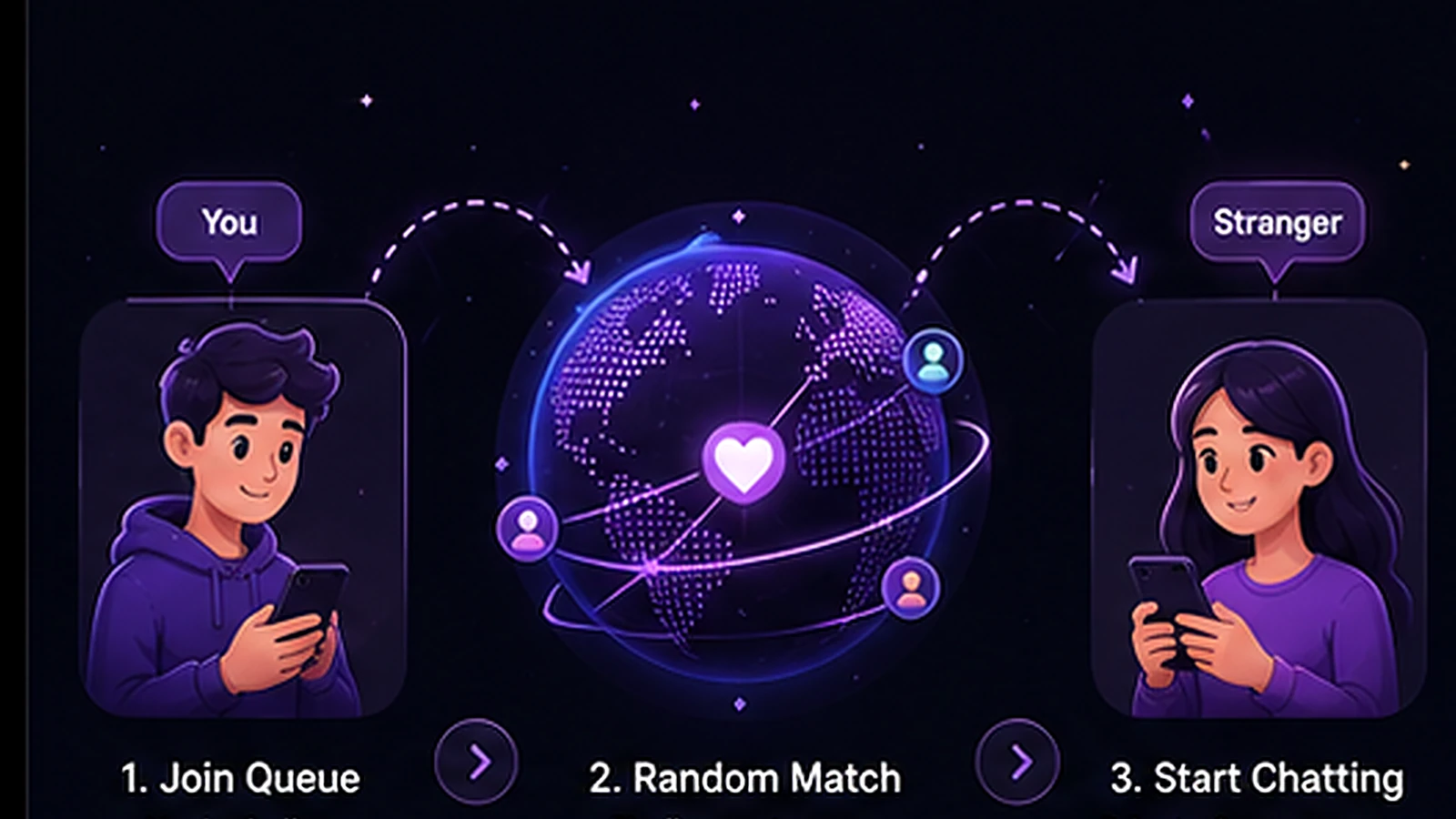
So a wave of platforms — StrangerChat among them — has returned to Omegle's original March 2009 formula: text-only, anonymous, one stranger at a time. Not as nostalgia, but modernized for how people actually use the internet now: built for the mobile browser first, no account or download required, and with active moderation designed in from the start rather than bolted on after the headlines. Text turns out to age remarkably well — it's low-pressure, genuinely anonymous, and vastly easier to keep clean. If you're curious what the 2009 formula looks like rebuilt in the 2020s, here's how StrangerChat works under the hood.
| Year | Milestone |
|---|---|
| 1988 | Jarkko Oikarinen creates IRC — real-time chat with strangers across the internet |
| 1997 | AOL chat rooms and AIM bring stranger chat to the mainstream household |
| March 2009 | Leif K-Brooks, 18, launches Omegle — text-only, "Talk to strangers!" |
| Nov 2009 | Andrey Ternovskiy, 17, launches Chatroulette — the video roulette mechanic is born |
| 2010 | Chatroulette peaks amid a media frenzy; Omegle adds video |
| 2020 | Lockdowns drive a massive resurgence — Omegle usage explodes |
| Nov 2023 | Omegle shuts down with a farewell letter and a tombstone |
| 2024–2026 | The alternatives era: users scatter, and text-first platforms revive the original formula |
The next chapter is a tap away
Seventeen years of history distilled to one button: random chat in its cleanest form — text-only, anonymous, moderated, free.
Random chat history — quick answers
Why did Omegle really shut down?
Not for lack of users. In his November 2023 farewell letter, founder Leif K-Brooks wrote that operating Omegle was "no longer sustainable, financially nor psychologically." Mounting moderation costs, sustained criticism over child safety, and litigation ultimately outweighed the will to keep it running.
Was Chatroulette or Omegle first?
Omegle, by about eight months — it launched in March 2009 as a text-only site. Chatroulette followed in November 2009 and, by adding live video, became the breakout media sensation of early 2010. So Omegle invented the format, while Chatroulette invented the video version most people picture.
Is random chat dying or growing in 2026?
Growing, but in a changed shape. Omegle's shutdown fragmented its audience rather than erasing it: video sites like OmeTV and Emerald Chat absorbed part of the crowd, while a newer wave of text-first, moderation-forward platforms revived the original 2009 formula. The appetite hasn't faded — the format is being rebuilt with safety as a starting point.
Why are new platforms going back to text instead of video?
Because the genre's worst problems were caused by the camera, not the conversation — unwanted exposure, recorded chats, and video feeds that are extremely hard to moderate at scale. Text is easier to keep clean, more genuinely anonymous, and lower-pressure, which is why the pendulum has swung back toward Omegle's original text-only idea.