How to Stay Safe While Chatting with Strangers Online
Let's get one thing straight: talking to strangers online is fine. Millions of people do it every single day — to pass time, practise a language, vent to someone neutral, or just enjoy a conversation with no history attached. The rare chats that go wrong follow surprisingly predictable patterns, which means you can learn to spot them in seconds. Follow a handful of rules and random chat stays what it should be — low-stakes fun. This guide is the complete set of those rules.
The golden rule: stay anonymous
Every piece of online-chat safety advice is a variation of one principle: anonymity is your armor. A stranger who knows nothing about you cannot harm you. They can't look you up, contact you elsewhere, embarrass you in front of people you know, or connect anything you say back to your real life. The moment the chat ends, you simply cease to exist for them.
That armor has exactly one weak point: you. On a platform with no accounts and no profiles, the only personal information in the conversation is whatever you choose to type. Keep the conversation blank — talk about ideas, opinions, music, weird dreams — and there is nothing for a bad actor to work with. Everything else in this guide is just this rule applied to specific situations.
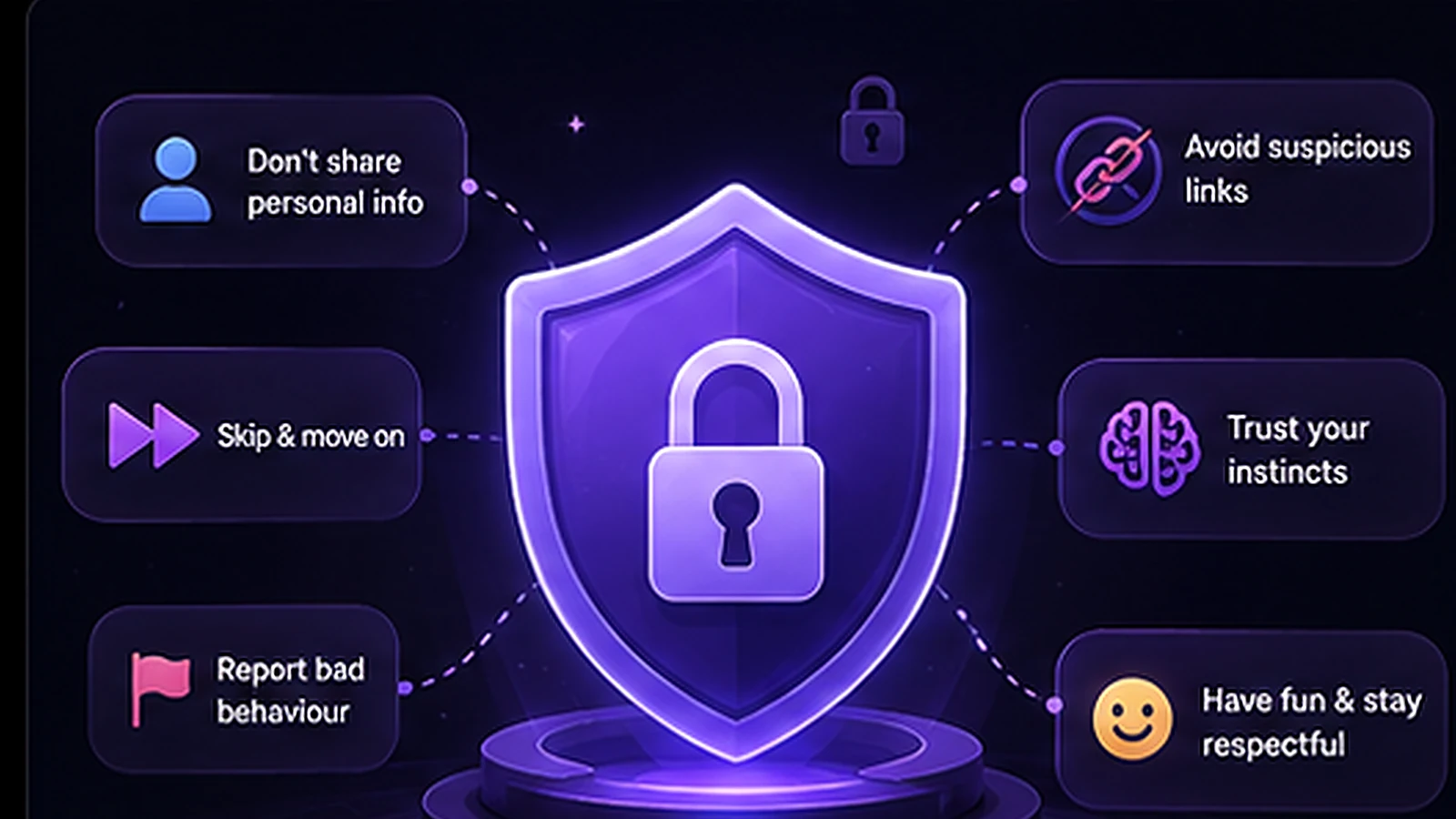
Information you should never share
Some details feel harmless on their own but stack up fast. Treat all of the following as off-limits in any anonymous chat, no matter how friendly the other person seems:
- Your full name. A name is a search query — one lookup can surface your socials, your city, and people you know.
- Your address or neighborhood. Even a vague "near the old cinema on the east side" narrows the map more than you think.
- Your school or workplace. These pin you to a physical location on a predictable schedule — the two things a stranger should never have.
- Social media handles. Handing over an Instagram or TikTok converts an anonymous chat into your full identity, photos, and friend list in one tap.
- Photos of yourself. A face is the single most identifying thing you own, and reverse image search makes any photo a lookup key.
- Phone number or email. Both are permanent contact channels that outlive the chat — and both are keys to account-recovery scams.
- Financial details. Card numbers, banking apps, payment handles, crypto wallets — there is no legitimate reason a chat stranger ever needs these.
One more subtle rule: watch out for combinations. Your first name, your city, and your favourite coffee spot are each harmless; together they can identify you. Someone steadily collecting small details isn't curious — they're assembling.
Red flags that a chat has turned into a scam
Scams in random chat almost always follow the same escalation script. Learn the five stages below and you'll recognise the whole play from its opening move:
- They push to move the chat to WhatsApp, Telegram, or Snapchat — fast. Usually within minutes, framed as "this site is glitchy" or "I'm about to lose you." Scammers want you off a moderated platform and onto a channel where they can keep contacting you. A genuine person is happy to keep talking right where you are.
- They ask for money, gift cards, or crypto. The wrapper varies — a stranded traveller, a sick relative, a frozen bank account, a "guaranteed" investment — but the core is identical: a person you met minutes ago needs a payment from you. There is no version of this that is real. The answer is always no.
- They fall for you instantly. Declaring deep feelings within one conversation is called love bombing, and it's stage one of every romance scam. The affection is the setup; the money request is the payoff, sometimes weeks later after patient grooming (the long version is known as "pig butchering"). Anyone in love after ten messages is in love with your wallet.
- They send links asking you to "verify your age or identity" or join a video site. These are phishing pages built to harvest your details, capture a password you reuse, or push malware. No legitimate person needs you verified on a third-party site to keep typing. Don't click links from strangers — any link, ever.
- They claim to already know things about you. "I can tell you're from Europe… you seem like a student… you've been hurt before, haven't you?" This is cold reading: vague guesses fired off until one lands, used to build false intimacy and pressure. Nobody can genuinely know anything about you from an anonymous text chat — treat confident "insights" as the manipulation they are.
Emotional manipulation 101
Not every bad actor wants money on day one; some just want leverage. The toolkit is small and worth knowing by name. Oversharing bait: they volunteer something deeply personal early, pressuring you to reciprocate with real details of your own. Manufactured urgency: "I need to know now," "answer quickly or I'm leaving" — rushing you so you don't stop to think. Guilt-tripping: "I thought you were different," "everyone abandons me" — making reasonable boundaries feel like cruelty. Flattery escalation: compliments that ramp from friendly to intense to demanding, so that saying no feels like a betrayal.
The defense against all four is the same: slow down. Manipulation only works at speed. And remember the asymmetry of anonymous chat — you owe a stranger nothing. Not an answer, not a reason, not a goodbye. Anyone who acts like you do is telling you exactly what kind of conversation this is.
How platform design affects your safety
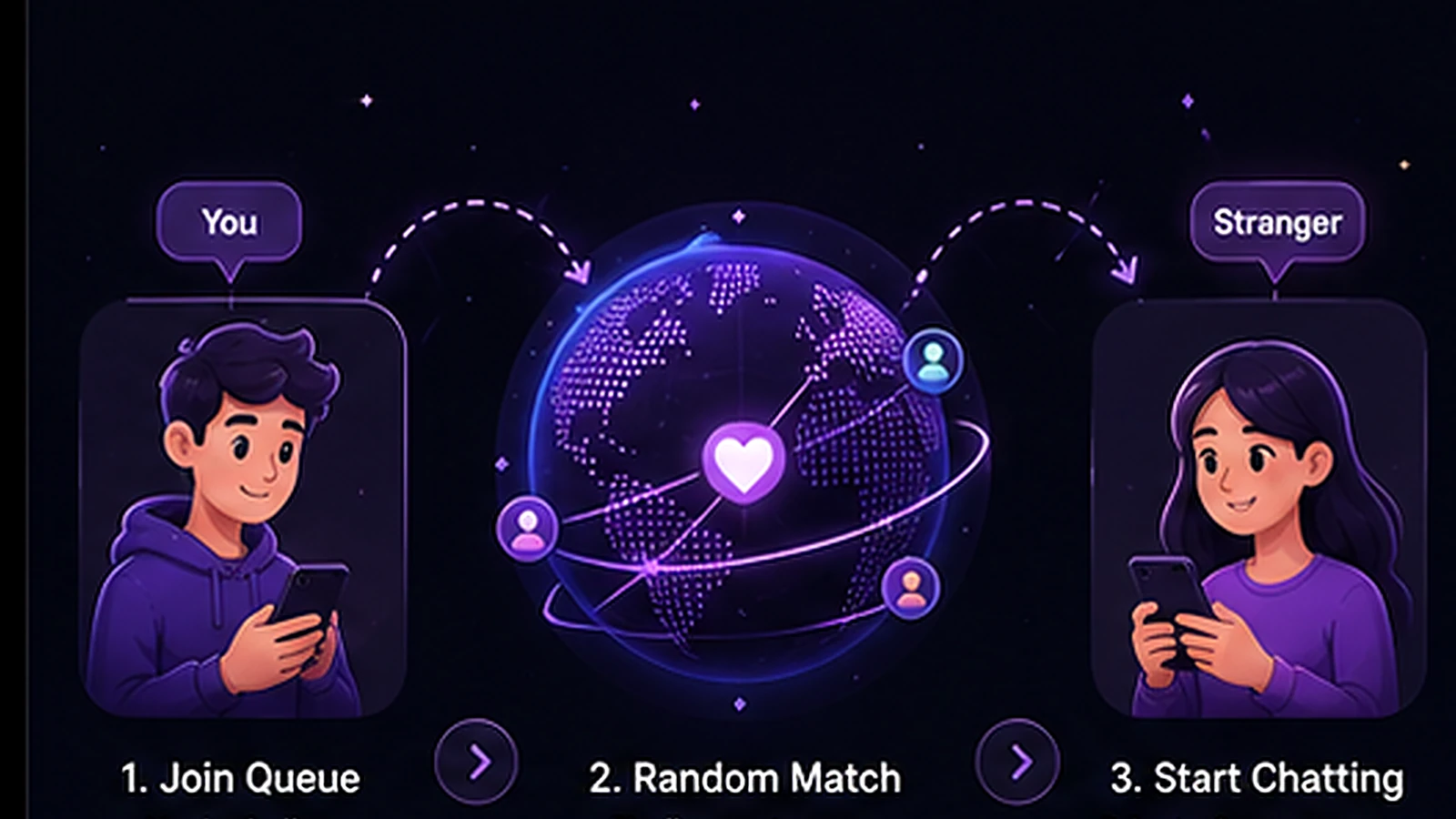
Here's something most safety guides skip: a large share of your risk is decided before you type a word, by how the platform itself is built. StrangerChat's design — no account, no history, text only — isn't minimalism for its own sake; each choice removes a whole category of exposure. No account means no email, password, or profile sitting in a database waiting to be leaked. No chat history means nothing survives the conversation — a transcript that doesn't exist can't be screenshotted or dug up later. And no camera means no face to capture and nothing for anyone to record. In short: nothing to hack, no face to screenshot, nothing to dox. You can read the full breakdown in how StrangerChat works.
Contrast that with platforms built around profiles. A profile is a dossier you write about yourself in advance — photo, name, age, interests, linked accounts — handed to every stranger before the first message. There, your safety depends on a security team and every stranger's good intentions; on an anonymous, ephemeral platform it depends only on what you choose to type. That's a much better bet.
Chat without leaving a trace
No account, no profile, no saved history — just a conversation that disappears when you do. Start anonymous, stay anonymous.
If something feels wrong: leave, skip, report
The most underrated safety tool in random chat isn't a filter or an algorithm — it's the skip button. One tap ends the conversation completely: the room is destroyed, the stranger has no way to find or re-contact you, and you're talking to someone new within seconds. No exit speech, no awkwardness, no cost to being "wrong" about a bad feeling. Skipping at the first hint of a red flag isn't rude or paranoid; it's exactly what the button is for.
If someone crosses a clear line — scam attempts, harassment, anything targeting minors — take one extra second to report them before you leave. Reports feed directly into moderation: patterns get flagged, repeat offenders get pulled from the matching pool, and the platform gets safer for the next person. And remember the simplest rule of all: nothing obligates you to keep talking. Not politeness, not the time you've invested, not the other person's reaction. The conversation ends the moment you say so.
That's the whole playbook. Stay anonymous, share nothing identifying, recognise the scam script, slow down when someone pushes, and skip without guilt. Do that, and chatting with strangers stays what it's always been: one of the internet's simplest pleasures. Ready to put it to use? Start with our tips on starting a great conversation with a stranger.
Safety questions, answered
Can a stranger find out who I am from a text chat?
Not unless you tell them. With no account, no profile, and no chat history, the only identifying information in a conversation is what you type. Keep names, locations, photos, and social handles out of the chat and you are effectively untraceable.
What should I do if someone asks me for money?
Refuse, report, and skip — in that order. A stranger asking for money, gift cards, or crypto is running a scam script regardless of how convincing the story sounds. Never send anything, and don't stay to argue: reporting takes a second and helps moderation catch them.
Is it safe to move a chat to another app?
It removes most of your protections. Off-platform, you lose moderation and reporting, and apps like WhatsApp can expose your phone number or profile photo. A push to switch apps quickly is itself a classic scam red flag — if a chat is good, it's good right where it is.
How do I report someone who breaks the rules?
Use the report option in the chat before you skip away. Reports are reviewed and repeat offenders are removed from the matching pool, so a one-tap report genuinely makes the platform safer for everyone who matches after you.