How to Start a Conversation with a Stranger Online
You know the moment. The match lands, the chat window opens, the cursor blinks — and your mind, which was full of things to say ten seconds ago, is suddenly a perfectly empty room. Everyone who has ever used a random chat site knows the blank-screen moment. Here's the good news: starting a conversation with a stranger isn't a personality trait — it's a skill with learnable mechanics, and the mechanics are surprisingly simple. This post breaks them down and hands you fifteen openers you can use tonight.
Why "hi" gets you skipped
In everyday life, "hi" works fine — at a bus stop or a party, the other person is more or less stuck with you, so a bland opener still leads somewhere. Random chat is different in one brutal way: the other person has infinite alternatives one tap away. The instant your message lands, they're weighing it against the next stranger in the queue.
"Hi" loses that comparison because it transfers all the work to them. You've said nothing they can react to, asked nothing they can answer, and revealed nothing about whether talking to you will be fun. That's effort asymmetry: you spent two letters, and you're asking them to spend a paragraph inventing a topic and carrying the opening. Most people resolve that math the obvious way — skip.
The fix isn't to write an essay. It's to make your first message do the work a first message is supposed to do.
The anatomy of a good opener
Every opener that reliably gets replies shares three properties:
- Specific. It gives the other person something concrete to react to. "What's the weirdest thing you've eaten?" beats "how are you" because it points at an actual topic instead of gesturing at the void.
- Low-effort to answer. A fun binary choice or a concrete question beats "tell me about yourself" every time. Nobody wants to write their autobiography for a stranger — but everybody can pick cats or dogs in two seconds.
- Playful. Tone travels. A first message with a bit of mischief in it signals "this chat will be fun," and fun is the entire reason anyone is here.
Notice what's not on the list: being clever, original, or impressive. Strangers aren't grading you — most genuinely want the conversation to work and are just waiting for someone to make it easy. If that sounds too optimistic, see the psychology of talking to strangers for why people consistently enjoy these chats more than they expect to.
15 openers that actually work
Steal these directly or use them as templates. Each one is specific, easy to answer, and sets a playful tone — and none of them require the other person to trust you with anything personal.
Curious openers
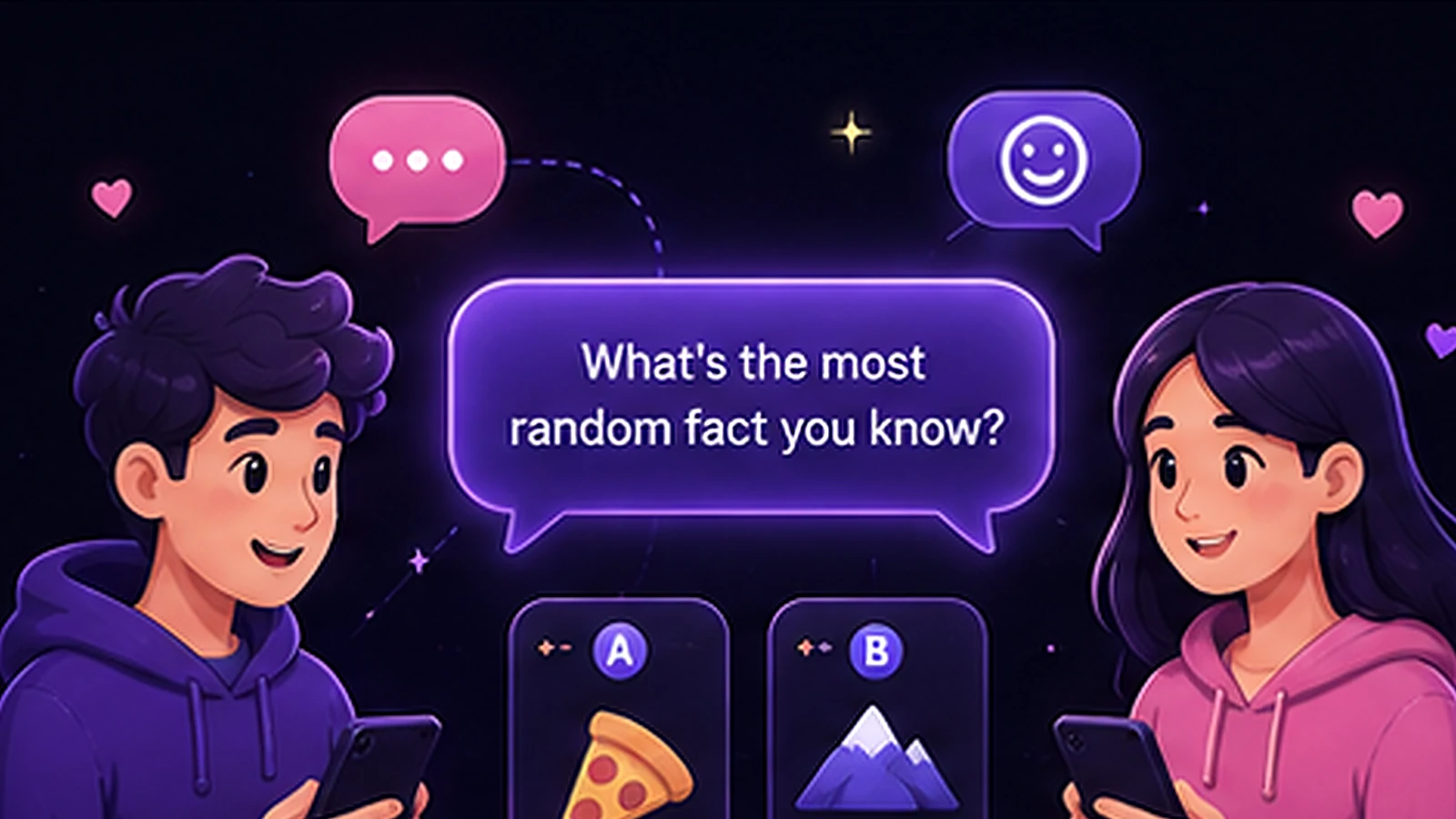
- "What's the most random fact you know off the top of your head?"
- "What time is it where you are? I'm trying to guess your continent."
- "What's something you're weirdly good at that never comes up in conversation?"
- "What was the last thing that made you laugh out loud — like actually out loud?"
- "If I could hear one song from your playlist right now, what would give me the most accurate impression of you?"
Playful openers
- "You have 10 seconds to convince me pineapple belongs on pizza. Go."
- "Quick, we're starting a heist movie crew. What's your specialty?"
- "I'm going to guess one thing about you and you tell me how wrong I am: you have at least three unfinished hobbies."
- "Settle a debate for me: is a hotdog a sandwich? Choose carefully, everything depends on this."
- "On a scale of 1 to 10, how good is your day going — and what would bump it up one point?"
Would-you-rather openers
- "Would you rather be able to pause time or rewind it by ten minutes?"
- "Would you rather never have to sleep again or never have to eat again?"
- "Would you rather know every language ever spoken or be able to talk to animals?"
- "Would you rather live one 1000-year life or ten 100-year lives with no memory between them?"
- "Would you rather always be 10 minutes late or always be 2 hours early?"
Got your opener ready?
Theory only gets you so far. Pick a line, hit start, and you'll be testing it on a live stranger in about five seconds — and if it flops, the next match is one tap away.
Ask questions, don't broadcast
A great opener buys you the first exchange; what you do next decides whether the chat lives. The single biggest mid-chat mistake is broadcasting — turning the conversation into a monologue about yourself and waiting for applause.
A useful guardrail is the 2:1 rule: aim to ask roughly as much as you tell. Share something, then hand the conversation back with a question. You don't need to count — just notice when you've sent three messages in a row about yourself and course-correct.
Two more habits separate good chatters from forgettable ones:
- Follow-ups beat new topics. If they mention they're learning guitar, "how long have you been playing?" is worth ten fresh topic changes. Jumping topics tells them you weren't really listening; digging in tells them they're interesting.
- React to specifics. When someone says their day was "chaotic but fine," don't reply "nice." Grab the interesting word: "chaotic how? I need details." Specific reactions are proof you're actually reading, and people open up fast when they feel read.
What makes strangers hit skip
Knowing what works is half the job; knowing what kills a chat instantly is the other half. These are the classics:
- Interrogation openers. The "asl" wall — age, sex, location fired off like a customs form. It signals you see them as a category, not a person, and it's the fastest skip in random chat.
- Instant oversharing. Trauma-dumping or launching into your life story in message two puts the stranger in a role they never agreed to. Warmth is earned over a conversation, not demanded in the opener.
- Copy-paste energy. If your message reads like it's been sent to forty people tonight, it gets treated like it was. Even one detail that responds to this conversation fixes it.
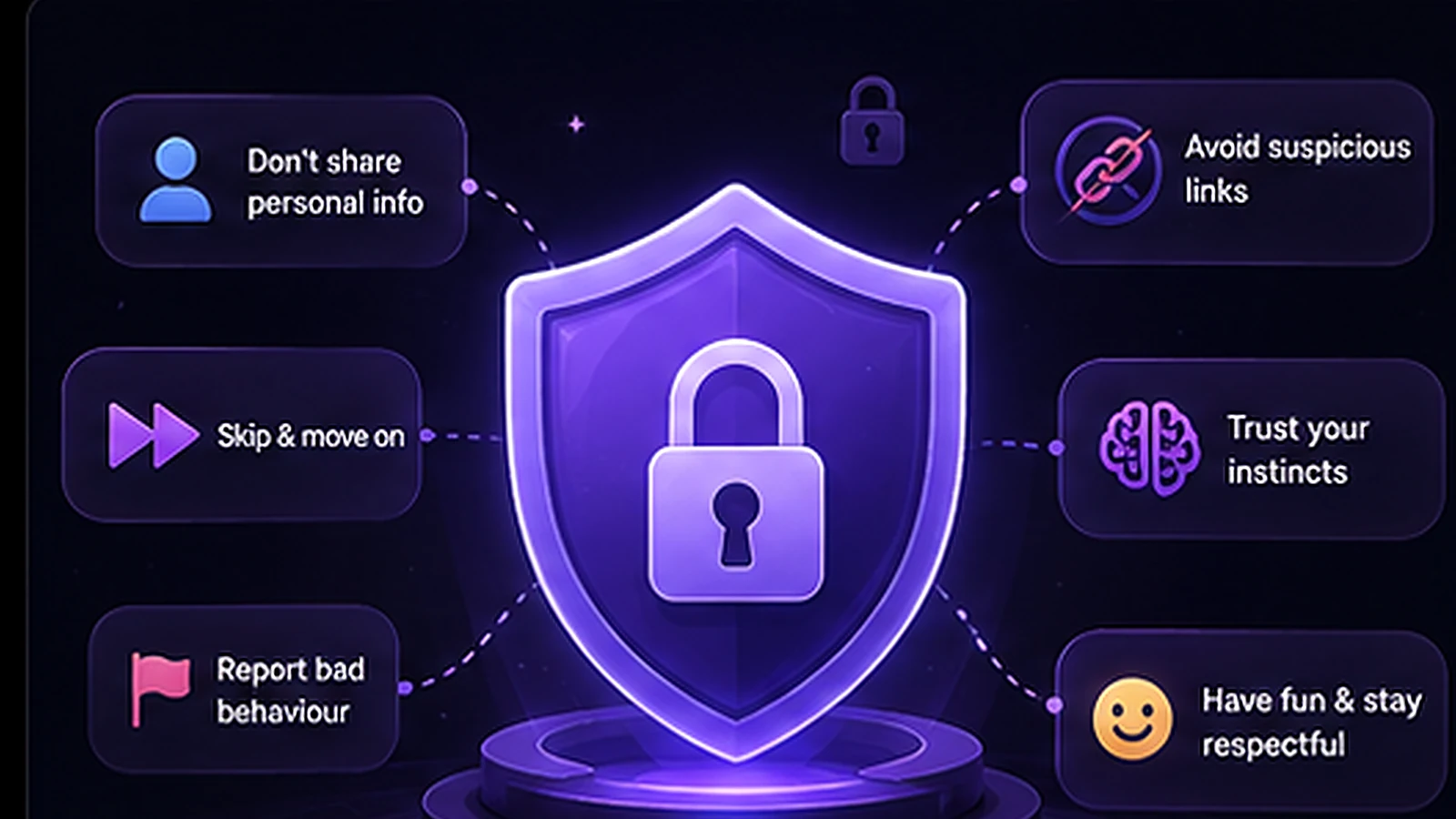
- Demanding personal info. Pushing for real names, socials, photos, or locations doesn't just kill the vibe — it's a genuine red flag. It's also exactly what our safety guide tells people to skip on sight, so expect them to.
- Negging and edgy openers. Opening with an insult, shock content, or "bet you're boring like everyone else" doesn't read as bold. It reads as a preview, and nobody wants the full show.
Keeping a good chat alive
Once a conversation has momentum, two techniques keep it rolling. The first is the callback: reference something they said earlier. If they mentioned a chaotic day at minute one and you ask at minute ten whether the chaos ever resolved, you've done something rare in random chat — you've remembered. Callbacks turn a string of messages into a shared conversation with its own tiny history.
The second is threading: in any answer they give, pull on the most interesting word. "I just got back from my cousin's weird wedding" contains at least three threads — the trip, the cousin, and whatever made the wedding weird. Pick the best one and tug. You almost never need a brand-new topic; the current answer is already carrying the next three.
And relax about pauses. In text, comfortable silences are fine — a gap while someone makes tea isn't awkward, it's just texting. Resist the urge to fill every lull with "you still there?" A good thread survives a five-minute gap easily.
Opener questions, answered
What do I say after the opener gets a reply?
React to something specific in their answer, then follow up on it. If your would-you-rather gets "pause time, obviously," ask what they'd do with the pause. The opener's job is to produce material — your job is to use it instead of firing off a second unrelated opener.
How long should I wait for a response before skipping?
There's no rule, but 30 to 60 seconds is a fair window for a first reply — some people are typing on phones or juggling tabs. Past that, skip without guilt; the queue will hand you someone more awake in seconds.
What if I run out of things to say mid-chat?
Scroll up. Almost every chat contains at least one thread you didn't pull — a detail they mentioned and you skimmed past. Call it back ("wait, you never told me how the weird wedding ended"). If the chat is truly out of fuel, ending it warmly and starting fresh is completely normal.
Should I reuse the same opener on every match?
Reusing a line that works is fine — this stranger has never seen it. What kills reused openers is autopilot: sending the line and ignoring the answer. Keep the opener, treat every reply as brand new.